Heta Leskinen, Work safety manager, Terveystalo
At Terveystalo, we have close to 400 different locations, and our procurement operations are highly regulated. This means that the chemicals we use are strictly controlled. Overall, we felt that our chemical management and chemical safety were not at the level they should be for an organisation like ours. We also feared that some locations were operating somewhat independently, not as centrally guided as we had hoped.

The system we were using at the time did not support centralised management. We were also concerned that the system hadn’t been implemented at all locations—chemical management, such as maintaining chemical lists, was being done manually. There were paper lists and printed safety data sheets stored in folders.
Given that our professionals spend a lot of time working at computer screens during the day, it’s very logical to share information through a system. If chemical registers are maintained on paper, someone has to manually update them, which takes time. If this happens across nearly 400 locations, it’s a massive workload. We had also received feedback during audits that our chemical management wasn’t at the required level.
The previous system had been acquired a few years earlier, and some market comparison had been done at that time. We assembled a group of chemical experts from different business units to explore available options. We looked into three different systems—approached vendors and explained our needs: the number of users and the volume of chemicals in use.
After discussions with three vendors, we felt that Kiwa Impact was the most ready and best suited to our needs. Other systems would have required significant customisation. While those vendors were open to it, we didn’t have the time or desire to develop someone else’s system. Chemical safety is important to us, but we also face many other risks in our work. We wanted the software to be smooth and easy to implement. We didn’t need fancy features—just up-to-date information, easy access to the chemicals we use, and a simple login process so everyone can find what they need.
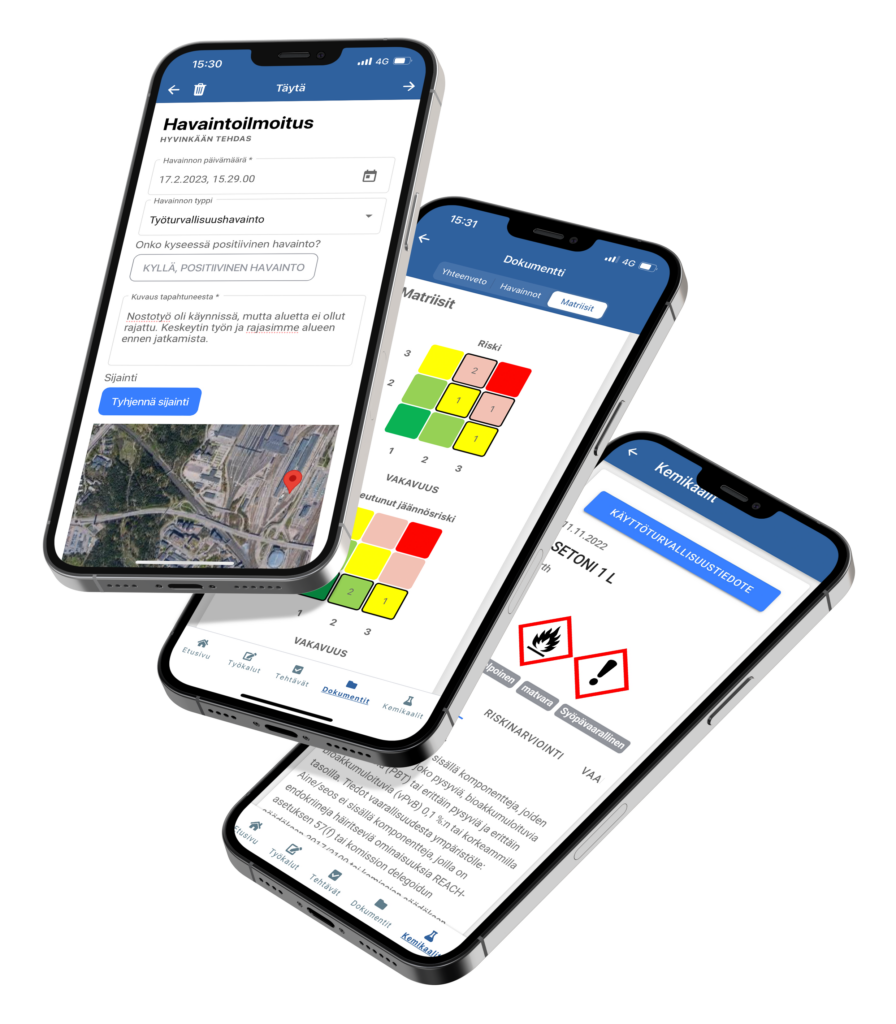
It has met our needs well. Implementation took place in November 2022, and 2023 was spent rolling it out across all our locations. I haven’t heard any surprising feedback—nothing like “we didn’t know this” or “the software works differently than expected.” The challenges have been more about our organisation’s readiness and ability to adopt and integrate the new system, rather than the system itself.
Depending on how you count, we have 300–400 locations, and internal communication was handled by safety officers. We concluded that chemical safety matters logically fall under their responsibilities. They are the main users of Kiwa Impact at each location, and I act as their counterpart at the corporate level. I also communicate with them regularly. Maintaining paper-based chemical lists was already their responsibility, so they were familiar with the topic. Now it’s easier—they can simply select the chemicals used at their location from Terveystalo’s master list.
I haven’t received such feedback. I suspect it’s because chemical updates weren’t previously done as thoroughly as they are now. Most of the feedback I get relates to usage instructions, user guidance, or the chemicals listed in Terveystalo’s register. Practically no issues or complaints about the system itself.
We already have other systems for all other functions, so the other modules of Impact aren’t currently an option for us. When we talk about incidents or safety observations, we mean events affecting personnel. We have a system and process for handling those, including root cause analysis and metrics. We also use Sense to track various safety indicators.
Expanding Impact’s use would require a major organisational change, which isn’t justified at this point. Our existing systems work well and are used for many other management, quality, and environmental tasks.
One of my tasks is to thoroughly review our chemical register. At launch, we reported around 500 chemicals, and now we have 700 in the system. We still have an internal list with nearly 100 more chemicals we might need. This has made us realise we need to reassess our chemical selection and volume—are all of them necessary?
We need to rethink our overall chemical safety. Systematic chemical risk assessment has also come up. Not all locations understand that chemical safety should be considered when selecting chemicals—can we choose a less hazardous option?
Once our lists are up to date and we’re confident that each location has the right chemicals for its needs, our top-level admin team will need to initiate risk assessments. We haven’t done that extensively yet.
We have nearly 14,000 users who were onboarded during implementation (access granted), 700 chemicals, and 300–400 locations. Despite the scale, everything went surprisingly smoothly. In the early days, there were minor delays in setting up new locations, but I haven’t heard of such issues in a long time. I also haven’t received any major feedback from our IT department, which handled all the technical aspects like data transfers.
1. Simplicity – It has exactly what we need, nothing extra.
2. User-friendly – Simple, easy, and visually intuitive. I can hand it over to a user and they’ll manage without special training.
3. Easy access to information – The necessary data is readily available when needed.